
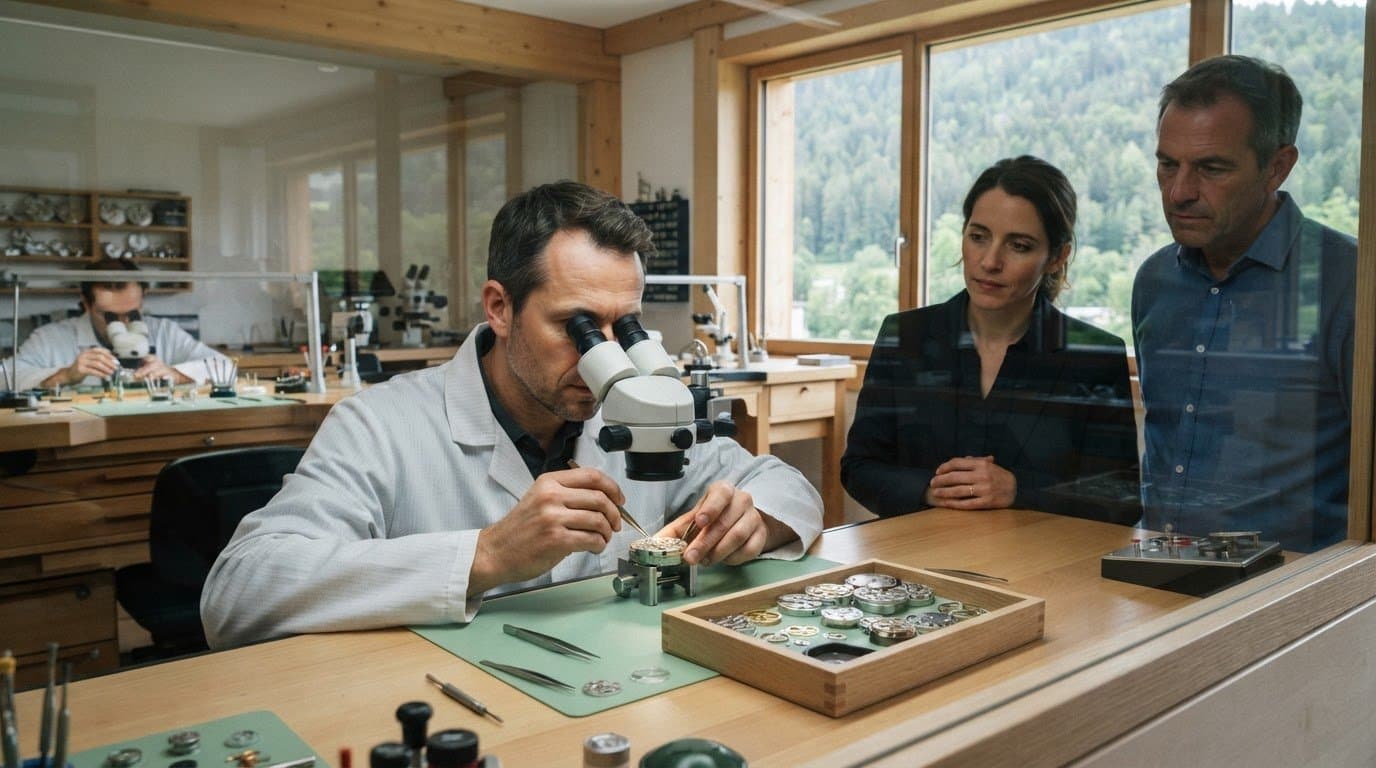
The Vallée de Joux offers a rare view of Swiss watchmaking beyond the polished dial. A visit to a high-end watch manufacture in Switzerland can bring you close to the region’s blend of precision technology and hand-finishing, while some manufactures offer exclusive visits by appointment. The Musée Atelier Audemars Piguet presents 200 years of watchmaking history, giving the valley’s craft a vivid sense of time and place.
It’s easy to see why the area draws curious collectors and travellers: workshops, heritage, specialist tools and the stillness of the Jura landscape all belong to the same story. This guide explains what makes the Vallée de Joux a centre of haute horlogerie, what a manufacture visit can reveal, and how museums and local scenery enrich the experience. You’ll also find practical context for planning a private journey through the region, from understanding the visit to shaping the wider Swiss itinerary around it.
Key Takeaways
- Discover how Vallée de Joux’s watchmaking heritage and mountain setting shape its reputation for haute horlogerie.
- Learn what automation can handle and where skilled hands remain central to watchmaking.
- Use museums and historic workbenches to explore the craft’s evolution and the tools behind precision timekeeping.
- Consider a private day tour or wider Swiss itinerary with Swiss Epic Tours to shape your journey around the region.
Vallée de Joux: The Heart of High-End Swiss Watchmaking
The Vallée de Joux brings watchmaking, mountain scenery and regional heritage together in one remarkable journey. Its workshops and museums help explain why this quiet Jura valley holds such a prominent place in high-end Swiss watchmaking.
Swiss Watch Valley Location and Access
Set in the Jura Mountains, the Vallée de Joux is about an hour’s drive from Geneva and Lausanne. It makes a distinct excursion from either city, with the route leaving urban streets for a landscape of forests, villages and Lac de Joux. The lake is the Jura Massif’s largest, and in winter it becomes Europe’s largest natural ice rink. When planning to visit a high-end watch manufacture in Switzerland, consider how the travel time and valley scenery fit into your day.
Visits to Brand Facilities
Some Vallée de Joux manufactures offer exclusive visits by appointment, giving watch enthusiasts a closer look at Swiss watches and how they are made. Access and arrangements vary by host.
Each manufacture sets its own visitor age limits, dress expectations and photography rules, so requirements differ across the valley. Costs depend on the host and visit format, while dates and times follow the individual manufacture’s schedule rather than a shared seasonal calendar. Languages also vary by host and appointment. When choosing a visit, consider these details alongside the journey itself.
Genevan and Swiss Watchmaking Heritage
The valley’s story sits within a wider Swiss tradition, with Geneva offering a striking complement. The Patek Philippe Museum in Geneva presents a collection spanning over 500 years, connecting historic timepieces with the craft’s continuing evolution. Its displays make heritage tangible, from intricate mechanisms to objects that show how watchmaking developed across generations.
Swiss-made and Swiss labels indicate a watch’s origin and are associated with quality in the watchmaking industry. Regional heritage and precision also shape how luxury watches are presented, giving them meaning beyond their materials. Exploring the valley alongside Geneva reveals how place, craft and carefully told stories contribute to Switzerland’s enduring watchmaking identity.
Automation and handcraft
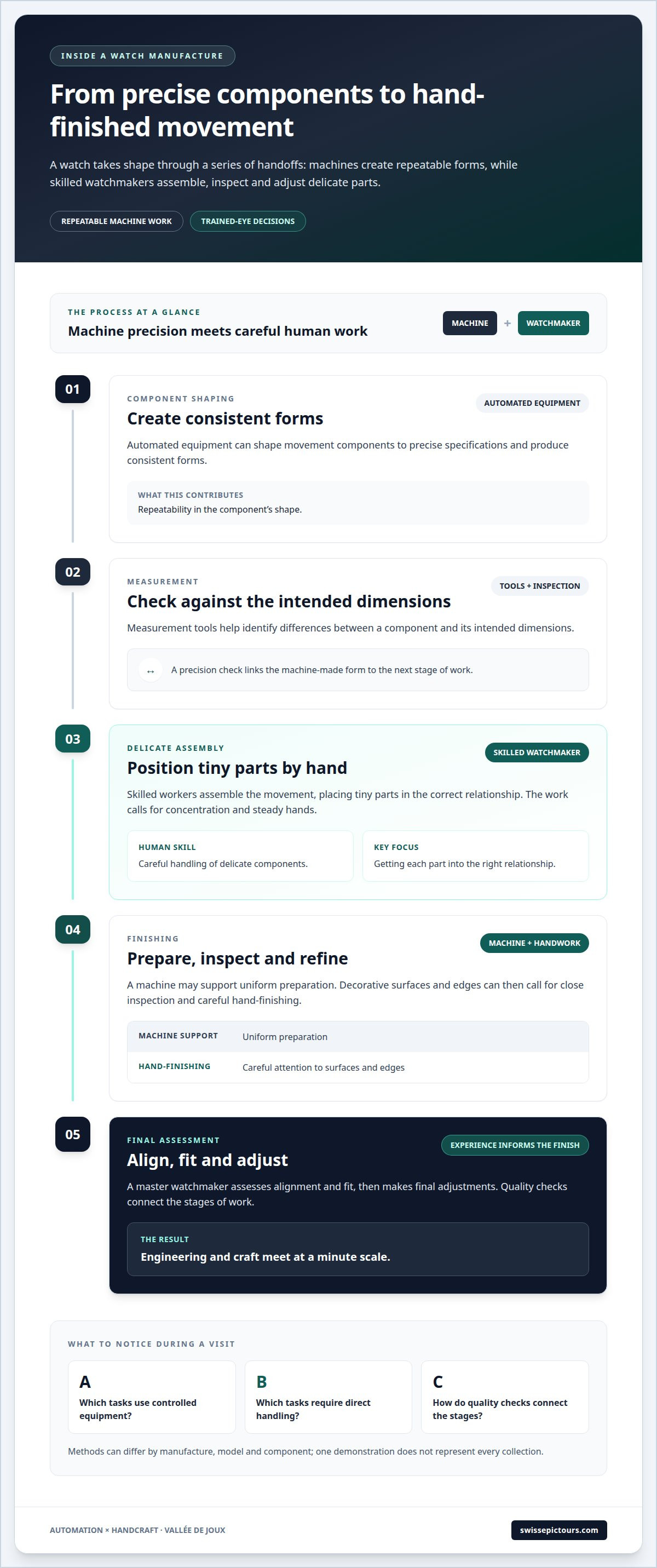
Modern watchmaking combines repeatable machine work with decisions that depend on a trained eye. Automation can shape components to precise specifications, while a watchmaker assembles and adjusts the movement. The balance varies by manufacture, model and component. A visit can reveal how people and machines each contribute to a finished timepiece.
Consider a movement component: automated equipment can produce consistent forms, while measurement tools help identify differences from the intended dimensions. Skilled workers then handle delicate assembly, positioning tiny parts in the correct relationship. This work calls for concentration and steady hands. Seeing these distinct stages helps visitors understand how an iconic watch is made.
Finishing offers another clear example. A machine may support uniform preparation, but decorative surfaces and edges can call for close inspection and careful handwork. A master watchmaker draws on experience to assess alignment, fit and final adjustment. These tasks help explain why a polished boutique display represents more than design: inside the case, engineering and craft meet at a minute scale.
During a manufacture visit, look for the handoffs between stages. Notice which tasks use controlled equipment, which require direct handling, and how quality checks connect them. Methods can differ across a brand’s collection, so one demonstration should not be taken as representative of every luxury watch. An exclusive visit can provide a focused view of the methods used at that facility.
To place the technical visit within a broader landscape journey, consider exploring private Swiss Alps tours. The contrast between precision work and the open alpine scenery adds another dimension to a Swiss itinerary.
Brand heritage and museums
Swiss watch brands carry distinct stories, shaped by place, invention and craftsmanship. Omega, Tudor, IWC and Breitling have decades-old relationships with their community. IWC’s founder, Florentine Ariosto Jones, fought with the 13th Massachusetts Infantry Regiment during the Civil War. Such details reveal how watchmaking heritage connects individual lives with the history behind a name.
In Geneva, the Patek Philippe Museum presents that history through objects and documents. Its collection comprises around 2,500 watches, automatons, precious objects and miniature enamel portraits. The museum library holds over 8,000 works devoted to timekeeping. Antique timekeeping items on display date back to around 1500, offering visitors a view of how designs and techniques evolved.
Look for milestones that show how a brand’s ideas moved into everyday watchmaking. The collection includes the first Patek Philippe wristwatch, made in 1868. It also houses the first known perpetual calendar wristwatch, made by Patek Philippe in 1925. These pieces connect named innovations with tangible examples, making the development of watchmaking easier to follow.
Other objects highlight technical ambition. Jean Adrien Philippe patented his stem-winding system in 1845. A Patek Philippe watch using that system was presented to Queen Victoria at London’s Great Exhibition in 1851. In 1989, Patek Philippe unveiled the Caliber 89 with 33 complications. Together, these milestones show how invention became part of a brand’s enduring identity.
The museum’s exhibitions also link heritage to contemporary interest. In 2026, it marked its 25th anniversary. Its Nautilus exhibition, marking the watch’s 50th anniversary, is scheduled to run until early 2027. As you explore, compare the objects, dates and design changes on display. That simple approach turns a museum visit into a clearer story of how Swiss watchmaking developed across generations.
Watchmaking workbenches and tools
A watchmaking workbench is designed for close, controlled work. Its surface gives a watchmaker a stable place to handle tiny components, while an orderly set of tools keeps what is needed within reach. Magnification brings small details into view, and fine tweezers and screwdrivers allow careful handling and adjustment. The bench is practical, but it also offers a glimpse into the focus behind mechanical timepieces.
The Patek Philippe Museum displays antique watchmaking workbenches dating back to the 19th century. Their presence shows how the craft depended on a dedicated workspace long before today’s precision equipment. Look at the arrangement and scale: a bench is built around the watchmaker’s hands and the components being worked on. That perspective helps visitors appreciate how tools serve the maker, rather than replacing skill.
Each tool has a specific role. Tweezers position a small part; a screwdriver secures a screw; magnification helps the watchmaker inspect details. During a demonstration, follow the sequence: observe the component, notice which tool is selected, then watch how the maker handles it. A curated tool display can tell a similar story, even when no movement is being assembled in front of you.
Workbenches also make the human scale of craftsmanship visible. A compact surface must accommodate delicate parts without inviting clutter, and a watchmaker’s practiced movements rely on familiarity with each instrument. The 19th-century benches at the museum invite comparison with contemporary workspaces, where modern equipment may sit alongside hand tools. The contrast helps explain continuity: technology changes, but patience and passion remain essential to careful work.
To pair a watchmaking visit with more of Switzerland’s landscapes, plan a private Swiss Alps tour. It’s a graceful way to set the intricate world of watch tools against the region’s wide-open scenery.
Swiss Epic Tours
Swiss Epic Tours helps travellers fit watchmaking into a wider journey through Switzerland. After exploring the Vallée de Joux’s workshops and heritage, a private day tour or Swiss Alps private tour can add regional scenery and cultural stops to your itinerary. For a broader route across the country, the Multi-day Grand Tour of Switzerland offers another way to shape the journey around your interests.
Choose the format that best suits your plans: a focused day on the road or a multi-day exploration. Swiss Epic Tours provides tailor-made, driver-guided tours, helping connect the practical journey with the places you want to discover. If you’d like to discuss your Swiss itinerary, contact Swiss Epic Tours.
Make the Journey Part of the Discovery
A watch manufacture visit can become a meaningful anchor for a wider Swiss journey. If you’re planning to visit a high-end watch manufacture in Switzerland, consider the atmosphere you want around the experience: a quieter day among alpine landscapes or a city-focused stay with time for culture and architecture. A Zurich City Tour can add an urban perspective to an itinerary centred on Swiss craftsmanship.
Swiss Epic Tours brings those travel choices together through tailor-made, driver-guided journeys. Whether you’re planning a route around one special visit or connecting it with other places across Switzerland, shape the itinerary around your interests and preferred pace.
Contact Swiss Epic Tours to plan your visit, and look forward to a journey where every stop adds its own character to the story.
Frequently Asked Questions
Which high-end watch manufactures in Switzerland offer factory tours to the public?
In the Vallée de Joux, some manufactures offer exclusive visits by appointment, but factory and museum visits are different experiences. The Musée Atelier Audemars Piguet is a dedicated place to explore watchmaking heritage, not a workshop tour. If seeing production is essential to your plans, distinguish a visit to a working manufacture from a museum visit before setting your itinerary.
How do I book a visit to a Swiss luxury watch manufacture?
Start by choosing the manufacture you want to see, then follow its appointment process. Have a preferred date, party size and questions about the visit format ready. Since access may be appointment-based, plan the rest of your day around the confirmed visit rather than assuming you can join a walk-in tour. Treat museum visits as a separate way to explore watchmaking heritage.
Which Swiss watch manufactures are easiest to reach by train or public transport?
There is no universal answer: public-transport convenience depends on the facility’s location and the onward connection from the nearest station. The Vallée de Joux is about an hour’s drive from Geneva and Lausanne, a useful reference for road travel, not a train comparison. For a rail-based day, consider the station-to-appointment leg and return connections when choosing your destination.
What can visitors see and do during a Swiss watch factory tour?
A manufacture visit can offer a closer look at the work done at that facility, though the experience depends on its visit format. Arrive ready to observe rather than expecting to handle components, since production areas are working spaces. Notice how a component moves through the stages shown and how the guide explains the decisions behind its construction.
Are there nearby museums, workshops, or attractions to visit?
Yes. The Musée Atelier Audemars Piguet in the Vallée de Joux offers a museum experience that explores the region’s watchmaking story. To add another dimension to the day, leave time for the valley’s landscape around Lac de Joux. Keep the schedule flexible enough to enjoy each stop rather than rushing between a museum, a manufacture appointment and a scenic outing.
What should I know about accessibility, cancellations, and other visitor restrictions?
Each venue sets its own visitor conditions, so plan around the specific appointment rather than assuming every brand follows the same rules. Before finalizing travel, review access needs, arrival instructions, photography limits and cancellation terms together. If anyone in your party has mobility considerations, allow time for the route from the transport drop-off to reception and the visitor area. These details can shape the pace of the day.