
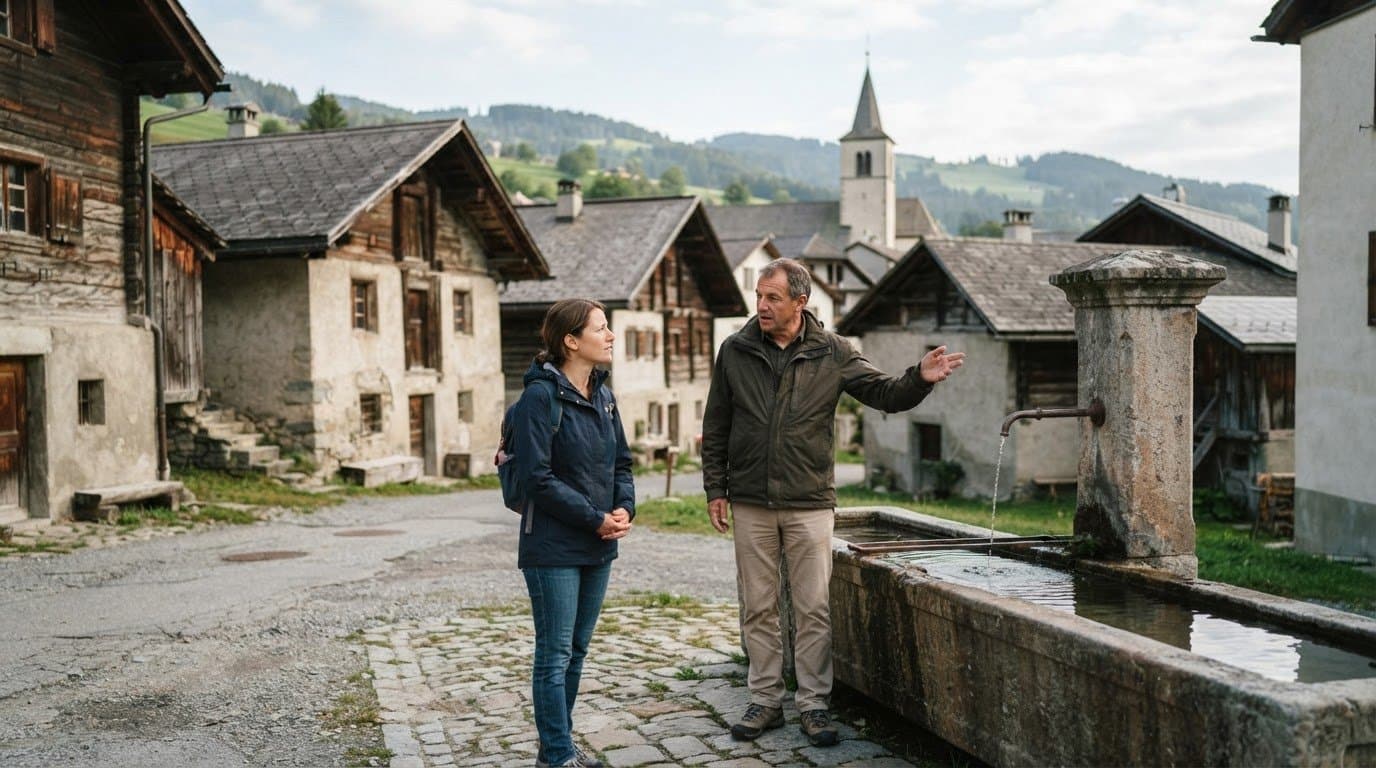
A Swiss family-history journey begins with a place, not a passport stamp. A tailored tour can connect a documented ancestral origin with nearby villages, landscapes, and historic towns. Personalized Swiss genealogy travel is most meaningful when the route reflects your family’s known origins. Swiss passports list the holder’s Heimatort, or place of origin, rather than their birth city.
You may already have family names, records, or a village passed down through generations. Turning those clues into a smooth, rewarding itinerary takes more than choosing scenic stops: the route, overnight stays, and transport should reflect where your family story leads and how you want to experience Switzerland.
This guide explains how a custom family-history tour can turn ancestry clues into a journey through your ancestor’s region, and what to consider when planning visits to ancestral villages and historic towns. You’ll also learn how to combine heritage stops with Switzerland’s alpine scenery for a personal journey from one destination to the next.
Key Takeaways
- A custom family-history tour can shape visits around your family’s clues and the places that matter most to your story.
- Professional genealogical research can help connect family records to a specific Swiss town or region before the itinerary is planned.
- Heritage stops can be paired with cultural experiences and memorable Swiss scenery to create a journey with personal meaning.
- Thoughtful route, accommodation, and transportation planning brings the trip together around your priorities and travel pace.
Custom family-history tours in Switzerland
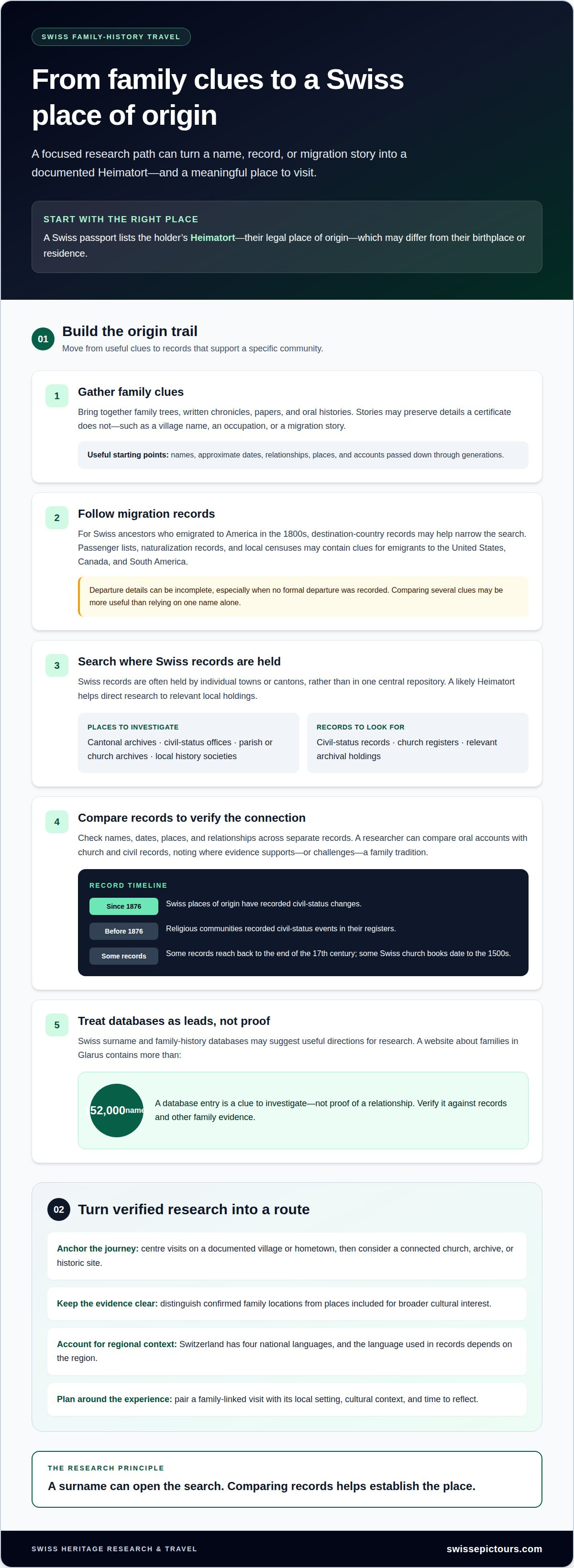
A professional genealogist can identify likely records by tracing an ancestor’s Heimatort, the legal place of origin, which may differ from their birthplace or residence. Civil-status records may be associated with a citizen’s place of origin as well as the place where an event occurred. Researchers can also locate church registers and relevant archival holdings, then use those findings to shape visits to ancestral communities. This connects family history with the landscapes and towns behind the names.
Research may involve cantonal archives, civil-status offices, parish or church archives, and local history societies. Swiss records are often held by individual towns or cantons rather than in one central repository, so an ancestor’s place of origin helps direct the search. When hiring a Swiss genealogist or local guide, look for experience with the relevant community and records, and findings that can inform a realistic travel route. A guide can add local context to visits, while documentary research establishes the family connections behind them.
Family trees and written family chronicles give researchers a working map of names, dates, and relationships. Oral histories can add details a certificate may not contain, such as a village name, family occupation, or story about migration. A researcher can compare those accounts with church and civil records, then note where records support or challenge a family tradition. Swiss surname and family-history databases may offer useful leads; a website about families in Glarus contains more than 152,000 names, though a database entry is a clue to investigate, not proof of a relationship.
Swiss places of origin have recorded civil-status changes since 1876, and some records reach back to the end of the 17th century. Before 1876, religious communities recorded civil-status events in their registers, and some Swiss church books date to the 1500s. Verification means comparing names, dates, places, and relationships across separate records rather than relying on a surname alone. The result can guide a personalized Swiss genealogy travel itinerary toward a specific Heimatort, church, archive, or village connected to the family.
Finding an ancestor’s place of origin
A professional genealogist can turn a family name, approximate date, or migration story into a focused search for an ancestor’s Swiss origin. They assess family papers, oral accounts, and records together, then follow promising leads in relevant local or cantonal holdings. A birthplace and a legal place of origin may differ, so identifying the right community matters before planning village visits. Research can also distinguish a documented connection from a family tradition that still needs evidence.
Migration history can narrow the search. Many Swiss ancestors emigrated to America in the 1800s, and records for Swiss emigrants to the United States, Canada, and South America may include passenger lists, naturalization records, and local censuses available online. A genealogist can compare a destination-country record with Swiss family information to identify possible places of origin. Departure details may be incomplete, especially when no formal departure was recorded, so several clues can be more useful than one name alone.
For families tracing an Atlantic crossing, an ancestry talk aboard a transatlantic sailing can offer a thoughtful way to explore migration context while travelling. It can connect a family’s known departure, destination, and period with the broader research questions a professional is investigating. The talk should complement documentary work, not replace it. Specific names, dates, and places give the discussion a personal focus and help shape the next stage of the journey.
Once a village or hometown is identified, a custom itinerary can centre on that place and nearby historic sites. A genealogist’s findings help prioritize meaningful stops, such as a family’s former community, a relevant church, or a local archive. The route can then balance research-related visits with time to experience the surrounding region. For a journey that pairs ancestral places with dramatic mountain scenery, Swiss Alps private tours can add a scenic element to the wider Swiss itinerary.
Custom heritage-tour itineraries
A strong heritage itinerary follows the evidence while making room for the experience of place. A professional can group confirmed family locations into a practical route, allowing time for a village visit, a church connected to family records, and nearby historic sites. If a marriage register identifies a community, that entry can become a meaningful stop rather than just a name in a family tree. The route should distinguish documented locations from places included for broader cultural interest.
Next, the itinerary can connect research stops with regional context. Switzerland has four national languages, and the language used in records depends on the region. This matters when interpreting a family name, reading a church inscription, or understanding local history. A visit to a French-speaking town, for example, may feel different from a stop in a German-speaking community. The professional can shape the journey around the ancestor’s region instead of treating Switzerland as one uniform destination.
Heritage travel can include cultural experiences beyond archives and historic buildings. A local market, traditional craft, or seasonal event can help you understand the community your ancestors knew. Germany’s Oktoberfest is one example of a cultural event that might feature in a genealogy itinerary, but it lies outside a Switzerland-focused route.
Keep the journey personal by organizing each day around a clear purpose: visit a family-linked place, explore its local setting, then leave time for reflection or a cultural stop. A church or historic town may anchor the day, with nearby heritage sites adding context without overwhelming the family story. This balance keeps the itinerary focused on ancestral connections while leaving room for vivid scenery, distinctive customs, and unhurried discoveries.
Travel routes, accommodation, and transportation planning
Begin with the locations your family research connects, then arrange them into a route that suits your priorities. A professional planner can group nearby ancestral places, historic sites, and regional experiences, reducing unnecessary backtracking. For example, a village visit can anchor a day, with a nearby town or landscape added around it. The number of overnight stops depends on the distance between destinations, your preferred pace, and how much time you want at each location.
Switzerland’s 26 cantons manage their own archives and official language, so the relevant canton can shape both research and travel logistics. The country has four national languages, and the language used in genealogical records depends on the region. This matters when planning visits with relatives or interpreting documents tied to a specific community. A researcher can account for regional language differences while the travel plan connects the relevant places efficiently.
Choose accommodation to support the route rather than dictate it. A central base may suit a cluster of family sites, while changing locations can make sense when research leads across distant regions. When arranging overnight stays, consider your preferred comfort, available time, and the day’s destinations. If a church, archive, or historic town is a priority, staying nearby can leave more time for the visit itself.
Transportation planning should reflect the itinerary’s geography, luggage, and pace, with transfers coordinated around arrival points and overnight stops. Share the family locations, travel dates, relevant documents, mobility needs, and plans to meet relatives; these details help shape a coherent journey. Swiss citizenship has three levels: national, cantonal, and Heimatort, a distinction that may appear in family documents. To include alpine scenery alongside heritage stops, plan a Swiss Alps private tour as part of your wider route.
Swiss Epic Tours
Once you’ve identified the places you want to visit, Swiss Epic Tours can shape the travel portion of your family-history journey. Its tailor-made private and driver-guided tours connect destinations through a coordinated route, with room for ancestral villages alongside historic towns and alpine scenery. Depending on your plans, a Multi-day Grand Tour of Switzerland, Swiss Alps private tours, or private day tours can provide a framework for exploring. The focus is on travel arrangements and experiences, not genealogical record research. Bring your preferred destinations and priorities to the planning conversation, especially if you want to balance family-related stops with scenic or cultural visits. Ready to plan your Swiss heritage journey? Contact Swiss Epic Tours.
Give your family story a place in Switzerland
The next step is to turn your family’s research into a journey that feels distinctly your own. Decide which places matter most, what you hope to experience there, and how much room you want for discovery beyond the ancestral route. These choices give a travel planner a clear starting point for shaping personalized Swiss genealogy travel around your priorities.
Swiss Epic Tours can organize the travel experience with options such as a Multi-day Grand Tour of Switzerland, a Zurich City Tour, and Swiss Alps private tours. These journeys can provide a scenic framework around the family-history destinations you’ve identified, with a route tailored to your interests. The genealogical research itself is separate; the focus is coordinating your Swiss travel experience.
Share your preferred destinations and the kind of journey you have in mind. Contact Swiss Epic Tours to discuss the travel arrangements, and take the first step toward experiencing your family story amid Switzerland’s remarkable landscapes.
Frequently Asked Questions
How can a professional help trace Swiss ancestry and identify a family’s ancestral village?
A professional genealogist can compare family documents with Swiss records to narrow down an ancestor’s community. For example, a surname written differently in a marriage record and a family letter may reflect a spelling variation rather than a separate branch. The genealogist assesses names, dates, and relationships together, then uses consistent details to guide further research into the family’s Swiss origins.
What does a personalized Swiss genealogy tour include, and how is it customized?
A personalized tour can bring family-connected locations together with cultural and scenic stops chosen around your interests. The itinerary might focus on a particular village, include time for a meaningful family visit, or balance heritage sites with regional experiences. Share your priorities, preferred pace, and destinations so the route reflects what matters to your family rather than following a standard sightseeing schedule.
How can a travel professional plan a Switzerland trip around ancestral villages, archives, and family sites?
A travel professional can sequence destinations by geography and coordinate travel arrangements around the places you want to visit. Provide the names of relevant villages, archives, and family sites, along with your travel dates and preferred pace. The planner can then organize the route and overnight stops so visits fit naturally into the journey, with room for personal time and regional discoveries.
What transportation and lodging options can a travel professional arrange for visits to remote Swiss ancestral villages?
Private, driver-guided travel can connect your chosen village with nearby family sites and overnight stops. A travel professional can coordinate transport and accommodation as part of the broader itinerary, taking your destinations, comfort preferences, and pace into account. Share plans to meet relatives or carry family documents so the arrangements support those priorities as well as the route.