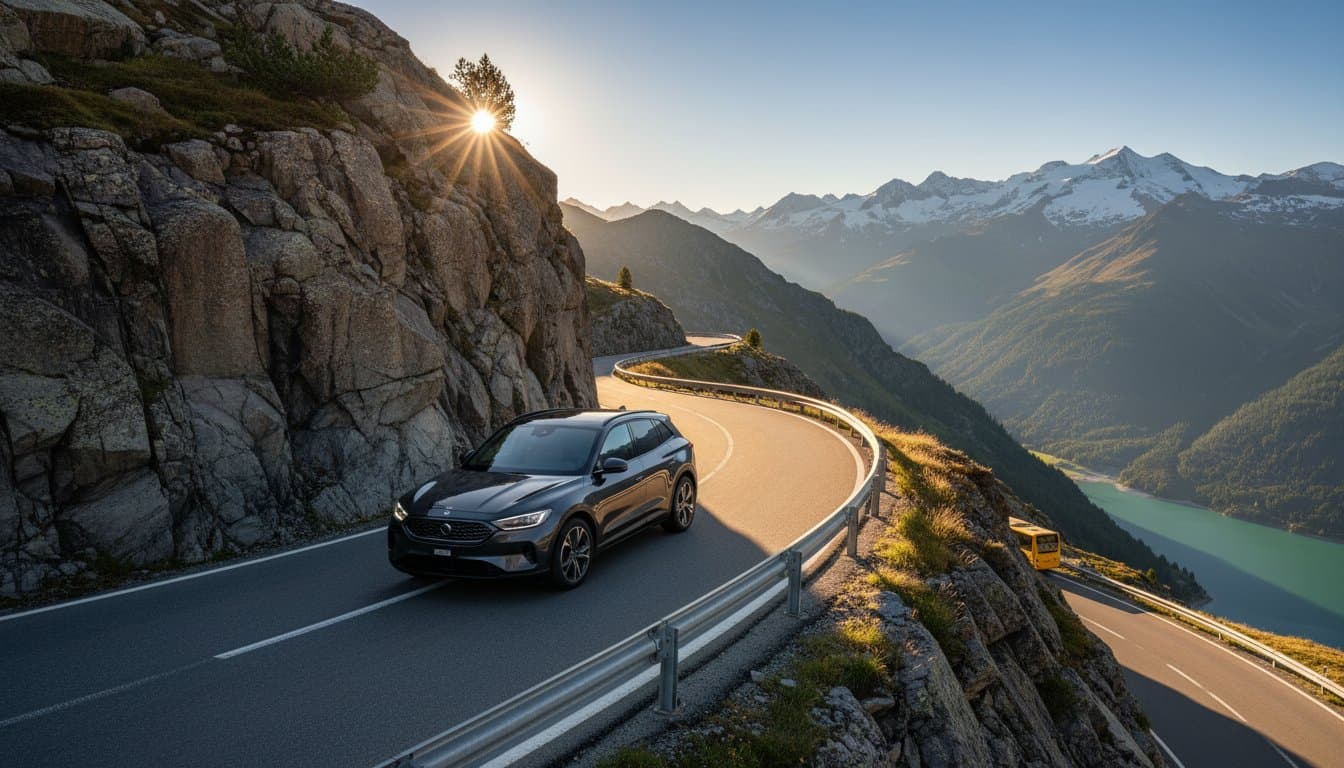
The most breathtaking view in the Swiss Alps isn't found at a fixed lookout point. It's the one you often miss because your knuckles are white, gripped tightly around a steering wheel while driving on a narrow cliffside road. You've likely envisioned yourself gliding through these majestic, pristine landscapes, yet the reality of a 12 percent gradient or a sudden encounter with a yellow Postbus can feel overwhelming. Master the art of navigating swiss mountain roads safely with our comprehensive 2026 guide. We designed this to transform your alpine anxiety into a feeling of refined excitement and total reliability.
It's natural to feel a sense of awe, and perhaps a little trepidation, when facing the unrivaled heights of Switzerland's legendary passes. You'll learn exactly how to handle the technical demands of steep descents without overheating your brakes. We'll also clarify the essential priority rules that keep traffic flowing smoothly, from the mandatory CHF 40 e-vignette requirements to the specific horn signals of the postal service. This guide provides the expert knowledge you need to decide when to take the wheel and when to choose a bespoke, private tour for a truly epic experience.
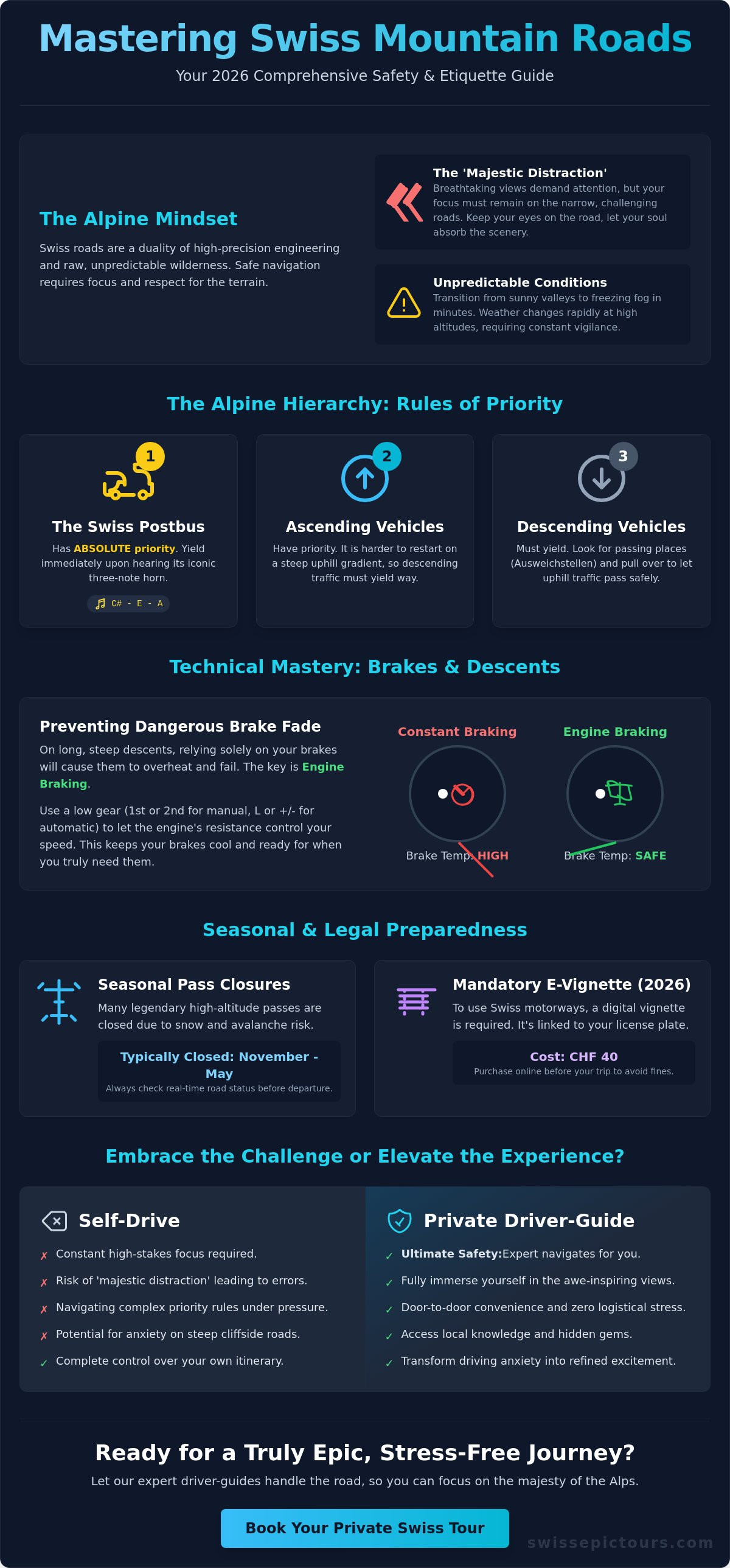
- Master the unwritten rules of alpine etiquette, including why ascending vehicles hold the right of way and how to respond to the iconic three-note horn of the Swiss Postbus.
- Protect your vehicle and your peace of mind by learning the essential technique of engine braking to prevent dangerous brake fade on steep, winding descents.
- Discover the secrets to navigating swiss mountain roads safely while managing the majestic distraction of Switzerland's most breathtaking, high-altitude landscapes.
- Stay compliant and prepared by understanding the 2026 digital vignette requirements and the seasonal closures that affect legendary passes from November through May.
- Learn when to embrace the challenge yourself and when to elevate your journey with a private driver-guide for a truly seamless and door-to-door experience.
The Alpine Mindset: Understanding the Unique Challenges of Swiss Mountain Roads
Driving in Switzerland is a masterclass in duality. You'll find yourself on roads that represent the pinnacle of high-precision engineering, yet they're carved directly into the heart of an unpredictable, raw wilderness. It's a sensory experience that demands your full presence. Navigating swiss mountain roads safely requires more than just technical skill; it requires a shift in your psychological approach. The 'Majestic Distraction' factor is a primary hurdle for many visitors. When you're surrounded by pristine glaciers and breathtaking peaks, it's tempting to let your gaze wander. However, on a narrow pass where the margin for error is measured in centimeters, your focus must remain fixed on the path ahead. Your eyes should be on the road, while your soul absorbs the scenery.
The variety of road classifications in the Alps can be startling. You might transition from a wide, three-lane motorway to a single-lane hairpin route with no guardrails in a matter of minutes. This transition requires immediate mental recalibration. Alpine Road Etiquette is a system of mutual respect and technical compliance.
Geography and Road Design
Understanding the comprehensive list of mountain passes is essential before you start your engine. Pass roads are fundamentally different from standard valley routes. They often feature gradients exceeding 12 percent and long series of tunnels that can disorient the unprepared. In 2026, many drivers still rely on standard GPS apps, but these often fail to account for the 'Alpine factor.' Tight hairpins and steep climbs mean a 20-kilometer stretch can easily take 45 minutes rather than the 15 predicted by your phone. Always plan for extra time to ensure your journey remains a pleasure rather than a race.
The Emotional Reality of High-Altitude Driving
High-altitude driving brings an emotional weight that many international travelers don't anticipate. Vertigo and cliffside anxiety are common when the road seemingly drops away into nothingness. The local mantra for safe navigation is 'slow and steady.' It's about maintaining a rhythm that respects the terrain. Weather is another factor. You can start in a sun-drenched valley and find yourself engulfed in thick, freezing fog at the peak within twenty minutes. This unpredictability is part of the epic journey, but it demands constant vigilance. If the heights feel too daunting, remember that our private tours offer the luxury of a professional driver, allowing you to focus entirely on the awe-inspiring views. Your journey should be about inspiration, not intimidation.
Essential Rules of Priority: The Yellow Postbus and Mountain Etiquette
The narrow, winding ribbons of asphalt that drape across the Swiss Alps require more than just technical skill; they demand a specific social choreography. Success in navigating swiss mountain roads safely depends on your understanding of the unwritten and written laws of priority. In the mountains, the rules of the road are designed to keep the most vulnerable or least maneuverable vehicles moving. The Golden Rule is simple yet vital. Ascending traffic generally has priority over descending traffic on narrow roads. It's far more difficult for a vehicle to restart or reverse while facing uphill on a steep gradient than it is to control a descent. If you meet another car on a path too thin for both, the driver heading down should be the first to look for a passing place.
The yellow Swiss Postbus possesses absolute priority on every mountain route, and drivers must yield immediately upon hearing its distinctive signal. This iconic vehicle is the undisputed king of the Alps. When you hear the famous three-note horn melody, a C-sharp, E, and A sequence inspired by Rossini's William Tell Overture, you must be prepared to stop or pull over. This signal isn't just a charming tradition; it's a warning that the bus is approaching a blind curve where it requires the entire width of the road. Even the most seasoned drivers should consult official travel and safety advice regarding these high-altitude routes, as the margin for error remains slim.
The Hierarchy of the Road
Beyond the Postbus, a clear hierarchy exists to prevent gridlock. Heavy vehicles, such as trucks and cars towing trailers, take precedence over smaller passenger cars regardless of direction. During the peak 2026 summer season, you'll also share these pristine routes with ambitious cyclists and hikers. Give them wide berths. If you're the one holding up a line of faster, local drivers, the polite Swiss custom is to pull into the next available passing bay and let them pass. This gesture of mountain etiquette ensures a smooth, stress-free journey for everyone involved.
Communication on Blind Curves
Clear communication is your best tool for navigating swiss mountain roads safely when visibility is limited. On narrow hairpins where you cannot see the exit of the turn, a short, sharp tap of the horn is legally required and highly encouraged to announce your presence. At night, a quick flash of your high beams serves the same purpose. When another driver pulls over to let you pass, a simple raised hand or a quick wave is the standard way to acknowledge their courtesy. This shared respect is what makes the Swiss driving experience so unique. If the thought of managing these complex interactions feels daunting, our Swiss Alps private tours allow you to surrender the wheel to a professional, leaving you free to simply admire the breathtaking peaks.
Technical Mastery: Handling Hairpins, Brakes, and Descents
To truly master the majestic passes of the Alps, one must move beyond mere steering and enter a state of technical harmony with the vehicle. Navigating swiss mountain roads safely is an art form that requires a deep understanding of physics, especially when dealing with the relentless pull of gravity. The scent of hot metal and pristine mountain air often signals the beginning of a long descent. On a 20-kilometer drop from a high peak, your brakes face an unrivaled test of endurance. Constant pressure leads to 'brake fade,' a terrifying phenomenon where heat buildup causes the braking system to lose its effectiveness entirely. Treating yourself to a 'brake cooling' stop isn't just a safety necessity; it's a chance to pause and let the silence of the peaks wash over you.
The secret to effortless control lies in engine braking. By matching your gear to the gradient, you allow the engine's internal resistance to regulate your speed, preserving your pads for when you truly need them. According to established Swiss mountain driving safety rules, you should never rely solely on your foot brake during a prolonged descent. Instead, use 'pulse braking'—short, firm applications of the pedal followed by complete release—to manage heat. When approaching the iconic hairpins of the Furka or Grimsel, follow the professional mantra: slow in, smooth through, and accelerate out. This ensures the car remains balanced and poised as you sweep through the curve.
Descending Safely: The Low Gear Rule
A reliable rule of thumb for any alpine explorer is to use the same gear to go down a mountain that you would use to climb it. If you're in second gear to reach the summit, stay in second for the journey down. If you detect the pungent, acrid smell of burning brakes, you must find a safe passing bay immediately. Don't stop and apply the handbrake, as this can warp the hot rotors; instead, let the car sit in gear while the air cools the system. This level of technical attention is why many travelers choose our Swiss Alps private tours, where expert drivers handle the mechanics while you enjoy the view.
Driving Electric Vehicles (EVs) in the Mountains
The 2026 driving landscape has been transformed by the rise of electric mobility. Driving an EV in the mountains offers a unique advantage: regenerative braking. As you descend, the motor acts as a generator, feeding energy back into the battery and providing natural deceleration. However, range anxiety remains a factor. Climbing a steep pass can consume 3x more energy than driving on flat roads. Fortunately, as of early 2026, high-speed chargers are now strategically located at the base of most major passes, ensuring your Multi-day Grand Tour of Switzerland remains seamless and sustainable. Your journey, your way, powered by the future.
Seasonal Preparedness and Navigating the Swiss Tunnel Network
The rhythm of the seasons dictates the flow of alpine travel with absolute authority. While the summer sun reveals the glory of the passes, winter transforms these majestic routes into inaccessible frozen wonders. Many legendary roads remain closed from November until as late as May or June, depending on the year's snowfall. Navigating swiss mountain roads safely means respecting these natural boundaries and planning with precision. Before you even reach the first ascent, ensure your vehicle is legally prepared for the journey. For 2026, the mandatory Swiss motorway vignette remains priced at CHF 40. While the traditional sticker is still available, approximately 35 percent of travelers have now embraced the digital e-vignette. This digital version is linked to your license plate and is valid from December 1, 2025, to January 31, 2027. Don't risk the CHF 200 fine for non-compliance; secure your status at the official e-vignette.ch portal before your journey begins.
Beyond the open air, Switzerland's engineering prowess is showcased in its unrivaled tunnel network. From the massive 17-kilometer Gotthard Road Tunnel to smaller, unlit alpine galleries, these passages require a distinct set of skills. Transitioning from the blinding glare of high-altitude snow to the dim, artificial light of a tunnel can be disorienting. It's a psychological shift that demands immediate adjustment and a steady hand. Your journey should feel like a seamless transition between worlds, not a moment of stress.
Planning Your Route for 2026
In the modern era, local knowledge is supplemented by high-precision digital tools. Rely on real-time apps to monitor for sudden rockfalls, construction, or unseasonal snow closures that can alter your itinerary in minutes. If a pass is closed, the 'Car Train' (Autoverlad) serves as an ingenious alternative, carrying your vehicle through the mountain while you relax in comfort. For a deeper look at the best times to visit and seasonal nuances, see our guide on Planning a Trip to Switzerland 2026. Preparation is the key to an epic adventure.
Tunnel Protocol and Emergencies
Safety within the mountain's heart is paramount. Always tune your radio to the specified frequency displayed at the entrance for emergency updates. While the 'two-second rule' is standard on open roads, you should double this distance in tunnels to account for reduced visibility and limited escape routes. If you encounter snow on the approach to a pass, remember that winter tires are essential. In many cantons, snow chains become a legal requirement rather than just a recommendation when signs are posted. If the logistics of vignettes and tunnel safety feel like a departure from your dream holiday, consider booking a Zurich Airport Transfer for a seamless, door-to-door arrival. We handle the technicalities; you enjoy the pristine landscapes.
Beyond the Wheel: Why a Private Driver-Guide is the Ultimate Safety Choice
The true cost of driving yourself through the Alps isn't measured in Swiss francs or liters of fuel. It's measured in the moments you miss. While you're focused on the narrow white line and the technical demands of a hairpin turn, you're missing the golden light hitting a glacier or the sight of a hidden alpine village. Navigating swiss mountain roads safely is a full-time commitment that leaves little room for wonder. There's a profound trade-off between being the operator of a machine and being a guest in a majestic landscape. By choosing a professional, you transform a potentially stressful transit into a curated, epic experience where the only thing you need to worry about is which lens to use for your next photo.
Expertise matters more than any algorithm. While navigation apps are useful, they can't predict the specific way the wind whistles through a pass or the exact moment a local herd of cows might decide to cross the road. Our professional chauffeurs navigate these high-altitude routes thousands of times yearly. They possess an instinctive understanding of the terrain that no tourist can replicate in a single trip. This seasoned mastery is the ultimate secret to navigating swiss mountain roads safely, providing a level of reliability that goes beyond standard safety protocols. It's the difference between merely surviving a drive and truly savoring the journey.
The Swiss Epic Tours Difference
We believe that true luxury is the absence of worry. Our bespoke itineraries are designed to showcase the most scenic passes, such as the Gotthard or the Furka, without the burden of driver's fatigue. You'll travel in premium vehicles specifically selected for their alpine stability and unrivaled comfort. This door-to-door service ensures that your journey remains intimate and private. For those seeking the pinnacle of high-end transport, our guide to Luxury Chauffeur Zurich offers a deeper look at how we elevate your travel experience. Your comfort is our priority.
Your Journey, Your Way
Choosing a private tour isn't just about safety; it's about discovery. A professional driver-guide acts as a storyteller, revealing the history and legends behind the peaks. You'll enjoy the freedom of spontaneous stops at hidden gem viewpoints that most self-drive travelers miss because they're too busy watching their brakes. This is the authentic soul of Switzerland, delivered with world-class hospitality. Ready for an epic adventure without the stress? Book your private Swiss tour today and step beyond the ordinary into a world of pristine beauty and total reliability.
Embrace Your Epic Alpine Adventure
The majestic peaks of the Swiss Alps are calling, and you now possess the essential knowledge to answer. From decoding the three-note melody of the Postbus horn to mastering the technical nuances of engine braking on steep descents, you're prepared for the high passes. You understand that navigating swiss mountain roads safely is a blend of respecting ancient mountain etiquette and staying current with 2026 digital requirements. These skills transform a daunting drive into a manageable journey through pristine landscapes.
The most profound realization is often that the best way to experience these unrivaled landscapes is to step away from the steering wheel. Our expert multilingual driver-guides and modern luxury fleet are ready to transform your transit into a legendary adventure. With our bespoke door-to-door itineraries, every hairpin turn becomes a moment of awe rather than a point of stress. Your journey should be an effortless immersion into the authentic soul of Switzerland, ensuring total reliability and world-class hospitality at every altitude.
Experience Switzerland's majestic passes with a professional driver-guide and discover the hidden gems that lie beyond the ordinary. The mountains are waiting; your epic story starts now.
Frequently Asked Questions
Is it difficult for Americans or UK drivers to navigate Swiss mountain roads?
It is significantly more demanding than driving on standard highways due to narrow lanes and steep 12 percent gradients. UK drivers must adapt to driving on the right while managing tight hairpins, whereas Americans often find the lack of guardrails on high passes disorienting. Navigating swiss mountain roads safely requires intense concentration, which is why many visitors choose a private tour to focus on the scenery instead of the cliffside.
What should I do if my brakes start to smell or smoke while descending a pass?
Pull over immediately at the next safe passing bay or viewpoint to allow the system to cool. Do not apply your handbrake, as the extreme heat can warp the rotors or cause the pads to fuse to the discs. Let the vehicle sit in gear for at least 20 minutes. To avoid this in the future, use a lower gear and rely on engine braking to regulate your speed during long descents.
Are snow chains mandatory in Switzerland during the summer months?
No, snow chains are not a legal requirement during the summer season, even on high-altitude routes. However, temperatures can drop rapidly above 2,000 meters, and light snowfall is possible even in July. While you won't need chains, it is vital to check the weather forecast before crossing a pass. If conditions turn wintry, local police may restrict access to vehicles without appropriate equipment.
How do I know if a Swiss mountain pass is open or closed?
Check the real-time status on the TCS (Touring Club Switzerland) website or look for the large electronic signs at the base of the mountain. Most legendary passes remain closed from November until late May or early June. If a road is marked "Geschlossen," it is physically blocked by snow or gates. Always verify the status before departing, as a closed pass can add hours to your journey.
What is the 'Postal Horn' and what should I do when I hear it?
The Postal Horn is a distinctive three-note signal used by yellow Postbuses to announce their presence on blind curves. When you hear this melody, you must be prepared to stop or pull over immediately to yield the road. These buses have absolute priority on mountain routes. Their drivers are highly skilled and expect you to provide enough space for them to navigate the tightest hairpins safely.
Can I drive a large motorhome or RV over the Furka or Grimsel passes?
Yes, but it is an elite challenge that requires exceptional spatial awareness and patience. The Furka Pass features gradients of 11 percent and sections that are extremely narrow for vehicles exceeding 7 meters in length. If you're driving a large motorhome, use the passing bays frequently to allow faster traffic to pass. This courtesy prevents gridlock and ensures a more pleasant experience for every traveler on the route.
Is there a special toll for driving on Swiss mountain roads?
Most mountain passes are free to use, provided your vehicle displays the mandatory CHF 40 motorway vignette. However, specific international tunnels like the Great Saint Bernard or the Munt la Schera require a separate toll payment. For 2026, ensure your e-vignette is correctly registered to your license plate before you begin your journey. This digital system is now used by approximately 35 percent of all drivers in Switzerland.
What are the rules for overtaking slow vehicles on steep uphill sections?
You should only overtake when you have a clear, unobstructed view of the road ahead and no solid white line is present. On steep gradients, it is safer to wait for the slower vehicle to pull into a designated passing bay. Navigating swiss mountain roads safely means prioritizing caution over speed. Never attempt to overtake near a hairpin turn or on a curve where your line of sight is limited by the rock face.