
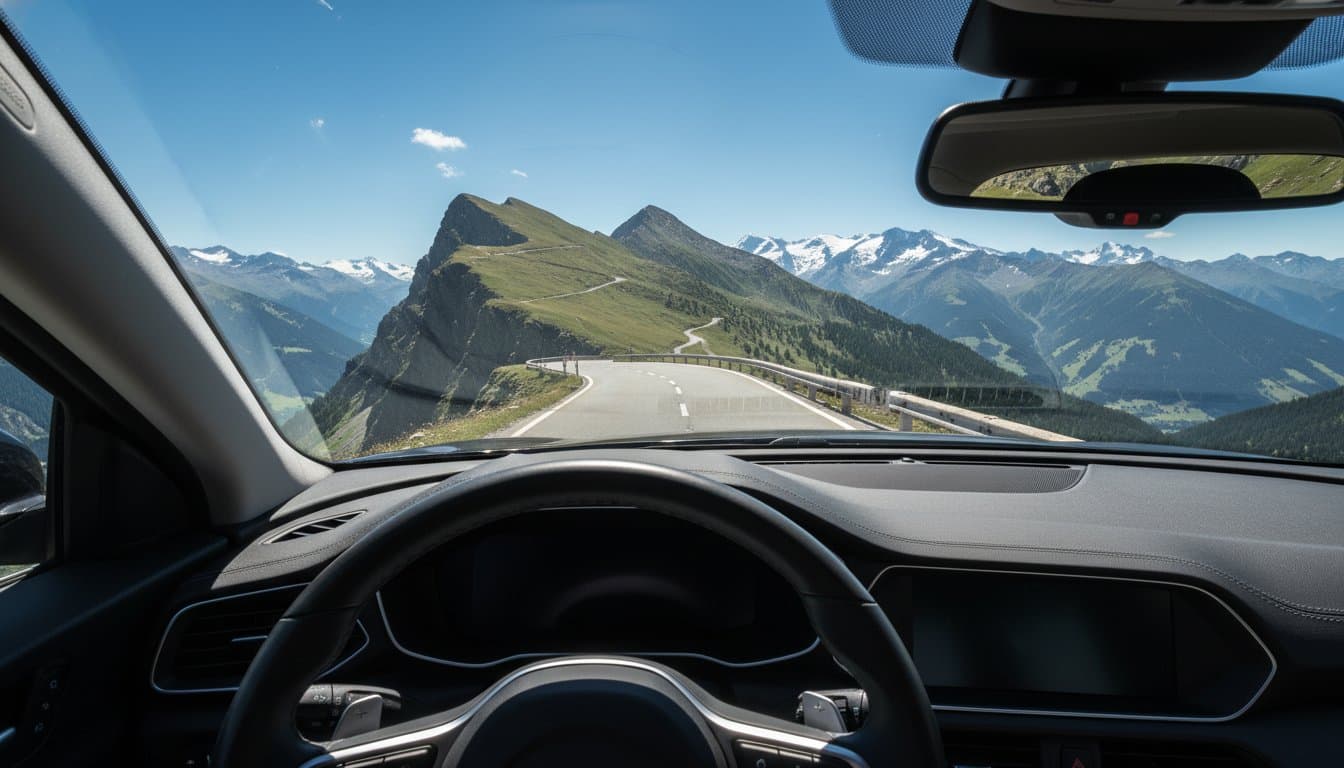
A single mistake on a Swiss motorway can cost you five times the price of your transit fee before you even reach the mountains. For many travelers, the dream of cruising through majestic mountain passes quickly dissolves into a cloud of anxiety over strict regulations and dizzying switchbacks. You likely find yourself asking: is driving in switzerland difficult for tourists who just want to soak in the pristine beauty of the Alps without a legal headache? It's a valid concern because while the tarmac is world-class, the rules are unforgiving.
We understand that your holiday should be about the awe-inspiring sight of the Matterhorn, not the stress of navigating narrow, steep roads or deciphering complex local signs. In this 2026 insider’s guide, you'll discover the reality of Swiss road life, including the mandatory 40 CHF e-vignette requirements and the latest automated driving laws. We provide a clear verdict on whether you should navigate these legendary landscapes yourself or opt for a bespoke, private journey that lets you experience the soul of Switzerland in total comfort. Your journey should be epic, not exhausting.
- Master the "Mountain Priority" rule to navigate narrow alpine switchbacks with the confidence of a local connoisseur.
- Learn why is driving in switzerland difficult for tourists who aren't prepared for a zero-tolerance legal culture where even minor speed infractions trigger hidden radar cameras.
- Essential preparation tips, from rigorous brake inspections to offline map downloads, ensure your journey remains safe through deep valleys and tunnels.
- Uncover the hidden gems of the Swiss landscape that GPS systems often miss, and how local expertise turns a standard route into an epic adventure.
- Weigh the mental tax of navigating steep gradients against the effortless luxury of a private chauffeur to find your perfect way through the Alps.
Is Driving in Switzerland Difficult? The Honest Truth for 2026
The honest answer to whether is driving in switzerland difficult for tourists is a fascinating paradox. On one hand, you'll find some of the most pristine, well-engineered roads on the planet. On the other, the psychological weight of navigating them can be immense. In 2026, the challenge has shifted from physical effort to mental vigilance. While the asphalt is smooth, the legal environment is sharper than ever. New digital monitoring systems and stricter environmental zones in major hubs like Zurich and Geneva mean that a single moment of distraction can result in a 200 CHF fine or a complex urban detour. For a local, these rules are second nature; for a visitor, they can feel like a tactical minefield.
The contrast between Switzerland's world-class infrastructure and its unforgiving alpine geography creates a unique tension. You are constantly balancing the desire to soak in the majestic, snow-capped peaks with the necessity of monitoring your speedometer with surgical precision. As of March 2025, the legal framework for automated driving began rolling out on motorways, but don't let that lull you into a false sense of security. The human element remains critical, especially when a sudden mist rolls over a mountain pass or a local driver closes the gap behind you on a narrow incline.
The Swiss Road Infrastructure Advantage
There is no denying the sheer brilliance of the Swiss transport network. The national roads are a marvel of human ingenuity, featuring over 1,200 kilometers of motorways and an intricate system of more than 200 tunnels that pierce through solid granite. Signage is standardized, clear, and follows international European conventions, making the "where to go" part of the journey relatively simple. Even in the depths of winter, the efficiency of the maintenance crews is legendary. They ensure that key routes remain open and safe, provided you've equipped your vehicle with the necessary winter tires and chains as indicated by local signs.
The "Mental Load" of Swiss Driving
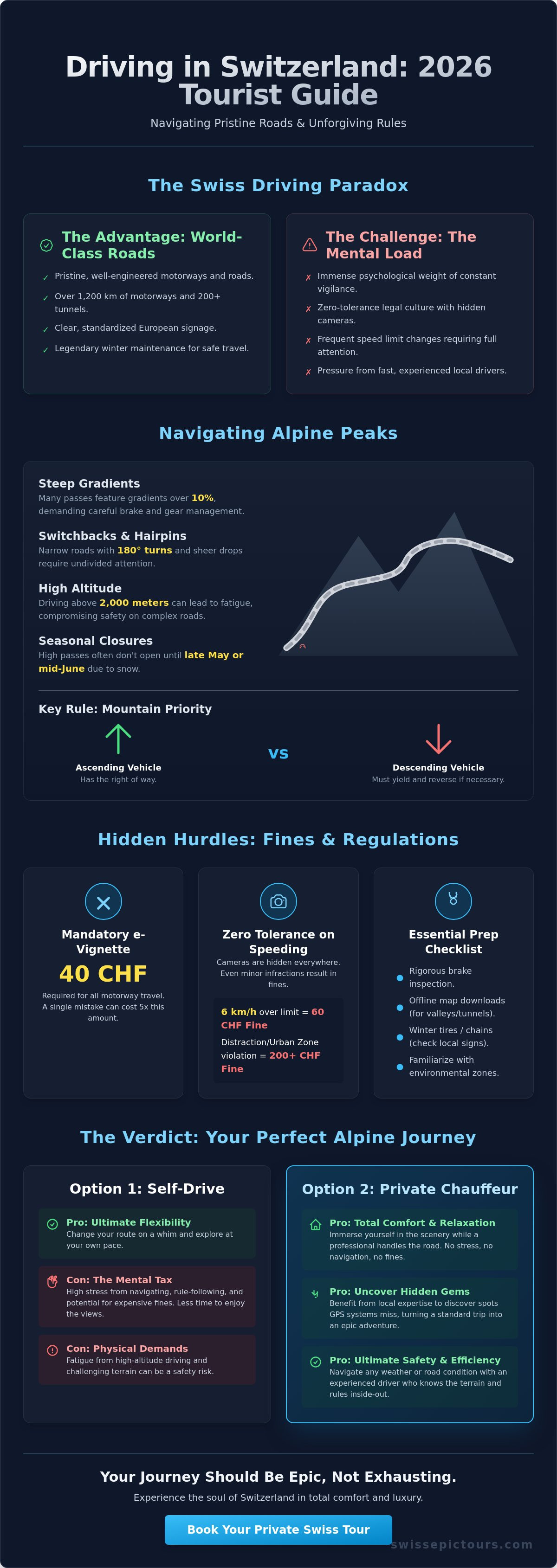
The real difficulty lies in the "mental load" that comes with Swiss precision. Speed limits can change every few kilometers, dropping from 120 km/h to 100 km/h or even 80 km/h in tunnels without much fanfare. Cameras are everywhere. They are tucked behind signs, hidden in tunnels, and mounted on trailers in rural villages. If you're 6 km/h over the limit, a 60 CHF fine will find its way to your mailbox. There's also the pressure of the local drivers. They know every curve of the Susten Pass and every shortcut through the Gruyères foothills. Trying to match their pace while your eyes are drawn to a breathtaking waterfall is a recipe for stress. This is why many find that is driving in switzerland difficult for tourists who simply want to relax and enjoy the unrivaled scenery.
Navigating the Alpine Terrain: Challenges of the Swiss Peaks
The sheer majesty of the Swiss Alps is undeniable, but for those behind the wheel, the beauty comes with a demanding physical reality. High mountain passes like the Furka or Grimsel often feature gradients exceeding 10 percent and hair-raising drops that test even the most seasoned drivers. You'll find that is driving in switzerland difficult for tourists who aren't accustomed to 180 degree switchbacks where the edge of the road feels uncomfortably close. The U.S. Department of State travel information confirms that while infrastructure is superior, the technical nature of these routes requires undivided attention. Driving at altitudes above 2,000 meters for four hours or more is physically taxing, often leading to fatigue that compromises safety just when the roads become most complex.
Timing is also a critical factor in your planning. Many of the most legendary routes remain under a thick blanket of snow long after spring has arrived in the valleys. High altitude passes often don't open until late May or even mid June, depending on the previous winter's snowfall. If you arrive too early, your planned route could be blocked by a seasonal closure, forcing a long detour through a tunnel. If the thought of these sheer drops feels more daunting than dreamy, exploring the Swiss Alps private tours allows you to surrender the wheel to a professional and simply enjoy the view.
Mastering the Switchbacks and Hairpins
Navigating a hairpin turn requires a specific technique. You must slow down significantly before the turn, looking far ahead to ensure no wide vehicles are approaching from the opposite direction. While many tourists opt for large SUVs for comfort, these can become a liability on narrow village roads or tight passes where every centimeter of width matters. On long descents, rely on engine braking by shifting into a lower gear. This prevents your brakes from overheating and failing, a common issue for those who "ride the brakes" down a mountain.
Post-Bus Etiquette and Alpine Rules
One of the most unique aspects of Swiss mountain driving is the iconic yellow PostBus. These buses have a distinctive three note horn, sounding C sharp, E, and A, which they use to signal their presence on blind corners. By law, these buses always have priority. You must be prepared to reverse into a passing place, known as an Ausweichstelle, to let them through. On steep, narrow roads where passing is impossible, the ascending vehicle always has priority over the descending one. Understanding these unwritten social cues is just as important as knowing the speed limit when deciding if is driving in switzerland difficult for tourists like yourself.
The Hidden Hurdles: Speed Cameras, Fines, and Regulations
The emerald valleys and snow-dusted peaks might suggest a land of relaxed wanderlust, but the Swiss legal system operates with the cold, unblinking precision of a luxury timepiece. In 2026, the technological net has tightened. Many travelers find that is driving in switzerland difficult for tourists who are used to the lenient "grace margins" found in other countries. Here, the culture is one of zero tolerance. A mere 3 km/h over the limit, after technical deductions, is enough to trigger a flash. These aren't just empty threats. Swiss authorities are exceptionally efficient at tracking down international visitors through rental agencies, ensuring that a moment of heavy-footedness on a pristine motorway follows you all the way home.
Beyond the speed traps, the logistics of simply remaining stationary can be a challenge. Urban parking is a complex tapestry of blue and white zones. White zones typically require payment at a central meter, while blue zones require a specific parking disc displayed on your dashboard to grant limited free time. In 2026, many cities have digitized these payments through local apps, adding another layer of digital literacy to your holiday requirements. If this sounds like a distraction from the breathtaking scenery you came to see, a Zurich City Tour provides a seamless way to explore without the stress of parking fines or navigating restricted environmental zones.
Unforgiving Speed Enforcement
The Swiss approach to speeding is legendary for its severity. Fines start at 20 CHF for a minor 1 to 5 km/h infraction, but they escalate rapidly. If you're caught traveling 6 to 10 km/h over the limit, you'll face a 60 CHF fine. Cameras are everywhere. They're often housed in unassuming grey boxes that blend into the landscape or are semi-stationary units moved between rural villages overnight. On the motorways, overhead gantries monitor your pace with unrivaled accuracy. It's a system designed for safety, but for the uninitiated, it can feel like a constant, low-level anxiety that pulls your eyes away from the majestic horizon and toward the speedometer.
Essential Documents and the 2026 Vignette
Compliance begins before you even turn the ignition. For 2026, the motorway vignette remains a mandatory requirement for all vehicles up to 3.5 tonnes. The price is fixed at 40 CHF, and the digital E-Vignette is now the standard, linked directly to your license plate. If you're driving a rental, don't assume it's already registered; always verify this before hitting the expressway. Failure to have a valid vignette results in an immediate 200 CHF fine plus the cost of the vignette itself. According to the RAC's guide to driving in Switzerland, you must also carry a warning triangle within easy reach of the driver, not tucked away in the boot. Remember that headlights must be switched on at all times, day and night, and the blood alcohol limit is a strict 0.05% for standard drivers.
Preparation Checklist: Essential Tips for Swiss Road Trips
The click of a seatbelt and the hum of a precision-engineered engine signal the start of something legendary. However, the preparation for a journey through the clouds requires more than just a sense of adventure. Many travelers ask is driving in switzerland difficult for tourists because they worry about the technical preparation required for such a unique landscape. In 2026, being ready means balancing digital tools with old-fashioned mechanical vigilance. Your vehicle's health is paramount; brakes and tyres are non-negotiable when you're descending 1,500 meters into a sun-drenched valley. While winter tyres aren't strictly mandatory by law in every canton, you're legally liable for any accident caused by inadequate equipment in icy conditions. This makes a thorough pre-trip inspection your first step toward peace of mind.
Navigation in the Alps presents its own set of sensory challenges. While modern GPS systems are marvels of technology, they often falter when you enter the depths of a granite tunnel or a sheer-sided valley like Lauterbrunnen. Always download offline maps before you depart. Relying on a live signal while climbing the Furka Pass is a gamble you don't want to take. Additionally, you must plan for the "Golden Hour." While the sunset over the peaks is a breathtaking sight, you should avoid driving high mountain passes after dark. The lack of street lighting and the presence of wildlife make these roads hazardous once the light fades. It's better to be sipping a glass of local Fendant in your chalet than white-knuckling a hairpin turn at midnight.
Budgeting for your epic journey is equally vital. Switzerland remains significantly more expensive than its neighbors, with a typical 7-day road trip estimated to cost between 3,000 and 5,000 CHF. Fuel prices and the mandatory 40 CHF E-Vignette are just the beginning. If the logistics of vehicle prep and mountain navigation feel like a barrier to your dream, our Swiss Alps private tours offer a seamless, luxurious alternative where every detail is curated for your comfort.
Choosing the Right Rental Vehicle
When selecting your chariot, remember that smaller is often better. While a massive SUV feels powerful, it can become a liability on the narrow, cobbled bridges of historic towns or when squeezing past a PostBus on an alpine ledge. If you're traveling during the shoulder seasons of May or October, 4x4 capability is a wise choice for unpredictable snow. For those choosing electric vehicles, Switzerland's charging infrastructure has expanded significantly in 2026, though you should still map out high-speed chargers in remote regions before you set off.
Itinerary Planning for Drivers
Realistic timing is the secret to a stress-free holiday. In the Alps, 50 kilometers is not the same as 50 kilometers on a flat highway; it can easily take 90 minutes to navigate the bends and elevation changes. Build in frequent breaks at designated viewpoints to avoid driver fatigue. For a comprehensive look at organizing your entire adventure, refer to our guide on planning a trip to Switzerland. This ensures your journey remains a sensory delight rather than a race against the clock.
The Epic Alternative: Why a Private Chauffeur is the Ultimate Luxury
While we've explored the technicalities of vignettes and the precision required for alpine switchbacks, the ultimate question remains. Do you want your Swiss holiday to feel like a tactical mission or a sensory masterpiece? For many, the realization that is driving in switzerland difficult for tourists comes not from the roads themselves, but from the missed opportunities. When your eyes are locked on the speedometer to avoid a 260 CHF fine, you aren't seeing the sunlight dance across the Aletsch Glacier. When you're white-knuckling a descent in a rental car, you aren't savoring the anticipation of a world-class meal in a hidden mountain hamlet. Choosing a private chauffeur transforms the journey from a logistical chore into a curated, legendary experience.
The transition from driver to guest is where the true magic of the Alps begins. Imagine reclining in a premium vehicle, a glass of crisp local wine in hand, while a professional navigator handles the "Mountain Priority" rules and narrow passes. There is a profound sense of total freedom that comes when you're no longer responsible for the "mental load" of Swiss regulations. You become a VIP observer of the landscape rather than a stressed participant in its traffic. This is the bridge to an authentic, stress-free adventure that honors your time and your desire for the extraordinary.
Beyond the Ordinary: Chauffeur vs. Self-Drive
The difference between a standard rental and a bespoke service is the presence of a local connoisseur. A professional driver-guide isn't just a pilot; they are a storyteller who brings the granite peaks and emerald valleys to life with history and local secrets. They know the "hidden gems" that a GPS signal in a deep valley will never reveal. With our luxury chauffeur Zurich service, your transit becomes a seamless extension of your holiday. Door-to-door service means no hauling luggage through train stations or hunting for elusive parking spots in car-free villages like Zermatt. It’s about unrivaled ease.
Your Journey, Your Way
Peace of mind is the rarest luxury of all. By surrendering the wheel to experts who navigate these majestic heights daily, you bypass every anxiety we’ve discussed, from hidden radar traps to seasonal road closures. You maximize your limited time, ensuring every hour is spent in awe rather than in frustration. We invite you to experience the pinnacle of luxury travel Switzerland without the driver’s seat stress. Why settle for a difficult commute when you can choose an epic journey? Your path through the Alps should be as pristine as the snow on the peaks. Your journey, your way.
Your Path to an Unrivaled Swiss Adventure
Navigating the peaks of the Alps should be a sensory feast, not a legal puzzle. While the infrastructure is world-class, the reality remains that is driving in switzerland difficult for tourists who value relaxation over technical precision. Between the mandatory 40 CHF e-vignette and the unblinking gaze of semi-stationary radar cameras, the mental load of self-driving often overshadows the breathtaking scenery. Your holiday is too precious to spend hunting for urban parking or worrying about a 200 CHF fine for a minor oversight on a 10 percent gradient.
Choose to see the soul of the mountains from the comfort of a premium cabin. Our professional multilingual driver-guides act as storytellers, unveiling hidden gems that no GPS can find. With a modern fleet of luxury vehicles and bespoke, door-to-door itineraries, we ensure your journey is as seamless as a Swiss timepiece. Experience the majesty of the Alps without the stress of the driver’s seat; book your private Swiss tour today. It's time to go beyond the ordinary and discover Switzerland as a VIP guest. Your legendary journey awaits.
Frequently Asked Questions
Is an International Driving Permit required for tourists in Switzerland?
An International Driving Permit is mandatory for any traveler whose home license was issued outside the EU, EEA, or UK. You must present this document alongside your original license during police checks or at border crossings. It is a simple administrative step that ensures your journey through the pristine cantons remains uninterrupted and legally compliant. This requirement allows local authorities to verify your credentials across Switzerland's diverse linguistic regions.
What happens if I get a speeding ticket in a Swiss rental car?
Your rental agency will typically charge an administrative fee of approximately 50 CHF to process your details for the Swiss authorities. The official fine, which starts at 20 CHF for exceeding the limit by just 1 to 5 km/h, will then be mailed to your international home address. Swiss police are exceptionally diligent in pursuing these payments across borders, and ignoring them can lead to significant legal complications on future visits.
Are Swiss mountain roads dangerous for inexperienced drivers?
Alpine roads present a unique set of challenges due to their narrow lanes, sheer drops, and unforgiving 180 degree switchbacks. This technical reality is a major reason why is driving in switzerland difficult for tourists who lack experience in high-altitude environments. Navigating a steep 10 percent gradient requires constant vigilance and a mastery of engine braking. For many, the mental pressure of these roads detracts from the majestic views they came to experience.
Do I need a special permit to drive on Swiss motorways?
You must have a motorway vignette to use any of the national expressways or motorways. In 2026, this permit costs 40 CHF and is available as a digital e-vignette linked directly to your vehicle's license plate. Failure to display a valid vignette or have a digital registration results in an immediate 200 CHF fine plus the cost of the permit itself. It is a small price for access to some of the world's most pristine infrastructure.
How much does parking typically cost in Swiss cities?
Expect to pay between 2 and 5 CHF per hour for street parking in major city centers like Zurich or Geneva. If you choose a secure, multi-story garage, the daily rate can easily reach 45 CHF or more. You must also be vigilant about the blue and white zone rules, as exceeding your permitted time by even a few minutes can result in a 40 CHF fine. Urban parking is often a logistical puzzle that requires local knowledge.
Can I drive to car-free villages like Zermatt?
It is impossible to drive directly into car-free villages such as Zermatt, Wengen, or Mürren. For Zermatt, you must leave your vehicle in a large, secure parking garage in the nearby village of Täsch. From there, a shuttle train departs every 20 minutes to whisk you into the heart of the car-free mountain world. This preserved tranquility is part of what makes these alpine wonders so legendary and pristine.
Is it better to take the train or drive in Switzerland?
While trains are famously punctual, they lack the door-to-door luxury and bespoke flexibility that a private tour provides. Driving yourself offers independence but brings the heavy burden of navigation, strict traffic laws, and mountain fatigue. A private chauffeur represents the ultimate middle ground, offering total relaxation amid the breathtaking scenery. It allows you to focus on the sensory beauty of the landscape while an expert handles the logistics. Your journey, your way.
What are the winter driving requirements for tourists in 2026?
In 2026, you are expected to equip your vehicle with winter tires marked with the snowflake symbol during snowy or icy conditions. While they are not strictly mandatory by national law, you face significant legal liability and fines if you cause an accident or block traffic without them. Snow chains are also required in specific high-altitude zones as indicated by local road signs. Being prepared for the elements is a hallmark of a sophisticated traveler.